Ensuring National Security through effective employment of Air Power
Our Mission
To train, equip and deploy a professional Air Force exploiting our core competencies to undertake air operations in support of National Security
Core competencies of the Sri Lanka Air Force
Mission: Air Defence
1. Detect, identify and destroy any hostile aircraft getting airborne within Sri Lanka or any hostile aircraft that attempts to penetrate Sri Lanka airspace.
It is the SLAFs premier core competency, to detect, identify and destroy any hostile aircraft getting airborne within Sri Lanka or any hostile aircraft that attempts to penetrate Sri Lanka’s airspace. It is the role of the SLAF to ensure that the skies above our nation are not used against it by those who wish it ill.
Mission: Surveillance and Recce
2. Strategic and tactical aerospace surveillance and reconnaissance operations over Sri Lankan territory (inclusive of the EEZ).
Strategic and tactical aerospace surveillance and reconnaissance operations over Sri Lankan territory is another one of our core competencies. Sri Lanka has a land area of over 65,000 square Kilometres as well as a territorial sea of 12 Nautical Miles, a Contiguous Zone of 24 Nautical Miles and Exclusive Economic Zone of 200 Nautical Miles. It is in the national interest to ensure that these areas are not exploited by external powers and that the treasures that are held within are preserved for the benefit of the nation and its people. This requires regular vigilance, periodic routine surveillance as well as reconnaissance as called for by specific requirements. This is a task that the SLAF is geared to meet and that it fulfils with pride and commitment.
Mission: Electronic Warfare
3. Exploitation of the electromagnetic spectrum for use by friendly forces and denial of its use by adversaries, through; ESM, ECM, EPM.
In the modern battlefield, information is power, and the transmission and receipt of information and the real time exchange of information between friendly forces is the key to a decisive victory. At the same time, one needs to ensure that the same capability is denied one’s enemy. This requires the exploitation of the electromagnetic spectrum for use by friendly forces and denial of its use by adversaries, through ESM, ECM, EPM. The SLAF is geared for and actively pursues its agenda in the electromagnetic spectrum, striving to dominate it for and on behalf of the nation.
Mission: Air strike
4. Precision strike capability required to defend Sri Lankan territory and territorial waters by day/night and in all weather.
An Air Force is called on to be capable of striking precisely when the situation demands, neutralizing critical centres of gravity even when it is located in close proximity to important national assets and innocent non-combatants. The SLAF’s precision strike capability is what enables it to minimize collateral damage and to ensure a high success rate to ensure that the military requirement is met without jeopardizing the public or valuable national assets.
Mission: Air Transport
5. Strategic, operational and tactical Airlift during day/night and in all weather for friendly forces and during Military Aid to Civil Authority (MACA) operations.
In times past, when the only lines of communication was by air, the SLAF provided a consistent flow of essentials to the embattled North. Today, in the glow of peace, it continues to transport goods, passengers and troops to and from the ends of the island, providing a reliable, effective and fast mode of transport for national requirements as well as to stimulate the emergence of an effective private commercial aviation industry. We continue to support our sister services in meeting their commitments and contribute towards the state objective of making Sri Lanka an aviation hub.
Mission: Force Protection
6. Comprehensive force protection for vital Air Force assets and installation.
In order to fulfil our mission of supporting national security, the SLAF has to ensure that it takes measures to protect its own assets. Our core competency of Comprehensive force protection for vital Air Force assets and installations is the sphere of activity that ensures that no harm befalls its ability to project air power in pursuit of national objectives.
Mission: Constant Readiness
7. Redundancy of operation by maintaining multiple bases equipped with facilities to ensure day/night/all weather operations.
The role of the SLAF is specialised and unique. At the same time, because of the nature of airpower and its dependency on the weather and other external factors, there is always an element of uncertainty of its availability at the time that it is required. Thus, there is a critical requirement for multiple backups to be maintained so that in the event of a failure at one location, multiple options are available to meet the requirement. Thus, redundancy of operation through maintaining multiple bases equipped with facilities to ensure day/night/ all-weather operations, is a core competency.
Mission: Rescue
8. Conducting SAR, CASEVAC and Air Maintenance operations by day/night and in fair weather
As an island nation, Sri Lanka has had its share of natural and manmade disasters. While little can be done to avert natural disasters and perhaps even some man made ones, the way we can mitigate the situation is by being able to react rapidly and to bring to bear the considerable resources vested with the SLAF in order to rescue and to affect relief measures. In this role, the Air Force has proven capabilities in conducting SAR, CASEVAC and Air Maintenance operations by day/night and in fair weather, within the Colombo FIR for an airliner / ship in distress with up to 300 survivors. In the event of a natural disaster within Sri Lanka and anywhere in the SAARC region and in support of offshore operations, the SLAF can deploy into action rapidly and immediately and assist local authorities to contain the disaster and to affect rapid relief measures.
Mission: VVIP Transport 9. VVIP transportation within the region.
The transportation of VVIPs including His Excellency the President of Sri Lanka is another mission that SLAF carries out with dedication. The SLAF’s extensive experience in the transport of VVIP’s and VIPs both in-country and within the region, and the dedicated VVIP fleet, have made it yet another of its core competencies.competencies.
Mission: Cyber Warfare
10. Ensuring friendly forces freedom of a action in cyberspace and denying adversaries its use.
The modern battlefield is not confined to the reaches of the physical world. It spans the information domain and is fought in cyber space. Understanding this and adapting to this is part of the challenge of a modern Air Force. This is why ensuring friendly forces freedom of action in cyberspace and denying adversaries its use, is yet another core competency of the Sri Lanka Air Force.
Source : Basic Doctrine of the Sri Lanka Air Force. (2018)
The National Flag
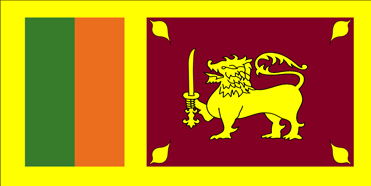
"Respect" the National flag and it will inspire you. This is the basic message of the National Flag. It is a message which should reach every Sri Lankan because the National Flag is a symbol of our motherland, our independence and the unity of our people. It is a symbol of our hopes and aspirations for the Nation's future. Our earlier National flag was the Royal Standard of the last king of Kandy.
It had a Lion in yellow holding a sword in its right fore-paw, on a crimson background, four pinnacles or spires also in yellow are at the four corners with border running right round. Our present National flag is a part of the constitution of the Democratic Socialist Republic of Sri Lanka promulgated on 07th September 1978. The Lion in yellow on crimson background has been retained. Four Bo leaves in yellow are at the four corners of the crimson background. Two vertical stripes of saffron and green of equal size represent the minorities.
Air Force Ensign
When the Royal Ceylon Air Force was established on 2nd March 1951 with GP Capt. G.C. Bladen as the Commander a proper ensign had not been designed for the Royal Ceylon Air Force. On 23rd February 1951 a commission was appointed to decide on the National Arms and Badges of Ceylon, and ceremonials and other uniforms.
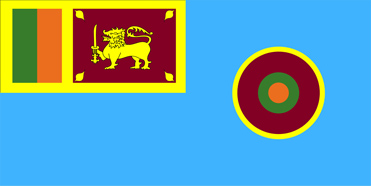
On 27th November 1951 the commission has recommended the use of the Air Force ensign. Air Force has replaced the Union flag of the RAF ensign with the lion flag which was the flag of the country at that time. The ensign is in sky blue colour with lion flag in the top left hand corner whilst the modified roundel of the RAF in the right hand corner
Air Force Roundel
When British aircrafts flew in battle for the first time in the First World War, they had no national markings, they were fired upon with equal impartiality by friend and foe from the ground. To enable British forces to identify British aircrafts, the Union Jack was painted on the upper and lower planes. Unfortunately, unless the aircraft was flying very low the cross on the Union Jack looked very much alike the German marking , and this did not solve the problem.
In October 1914, it was decided to adopt the more easily distinguishable three circles of red, white and blue then in use by the French Air Force , but the colours were reversed to blue white and red by the British. This roundel became the unofficial badge and battle colours of the British Air Force during the 1914-1918 war and have been carried into battle in all parts of the world.
When the Royal Ceylon Air Force ensign was designed in 1951, the RAF roundel of blue white and red was slightly modified by adding two wings of yellow and red, the Colours of the Lion flag at the time - on both sides of the Roundel. The three circles were changed to two circles of red/crimson and yellow with green and saffron wings depicting the colours of the present National Flag. The present SLAF Roundel, slash off its wings, continues to depict the colours of the National Flag but in four concentric rings with the area of the colours representing the ratio of the appearance of those colours in the National Flag.
The RAF pamphlet "Customs of the Services" states that countless numbers have died maintaining its prestige. However when the Royal Ceylon Air Force ensign was designed in 1951, the RAF roundel of blue white and red was slightly modified by adding two wings of yellow and red/crimson to either side of the roundel. ( Colours of the lion flag which was the flag of the country at that time.)
The Royal Ceylon Air Force then like other Air Forces decided to use this roundel as an Air Force ensign with colours of the flag of its particular country. Subsequently the three circles were changed to two circles of red/crimson and yellow with green and saffron wings depicting the colours of our present National flag of the country.


 When the Royal Ceylon Air Force was established on 2nd March 1951 with GP Capt. G.C. Bladen as the Commander a proper ensign had not been designed for the Royal Ceylon Air Force. On 23rd February 1951 a commission was appointed to decide on the National Arms and Badges of Ceylon, and ceremonials and other uniforms.
 When British aircrafts flew in battle for the first time in the First World War, they had no national markings, they were fired upon with equal impartiality by friend and foe from the ground. To enable British forces to identify British aircrafts, the Union Jack was painted on the upper and lower planes. Unfortunately, unless the aircraft was flying very low the cross on the Union Jack looked very much alike the German marking , and this did not solve the problem.


